Focusing on the technology, industry applications, and corporate practices related to filling and sealing equipment, we continuously share professional content on equipment selection, production line upgrades, quality inspection, and smart manufacturing.
Equipment Selection GuideProduction Line Upgrade PlanKey Points for Quality InspectionIndustry Trend Insights
Skincare product manufacturing involves a variety of materials, such as toners, serums, lotions, face creams, and balms, while packaging materials include round bottles, square bottles, glass bottles, and PE bottles, among other forms. Relying on manual labor for bottle loading, filling, capping, weighing, and cartoning not only slows down the workflow but also leads to issues such as weight fluctuations, missing caps, and difficulties with batch traceability.
The value of a fully automated lotion and cream filling production line lies in its ability to integrate previously disparate equipment and manual workstations into a continuous process, enabling automated production from the arrival of empty bottles to the packaging of finished products.
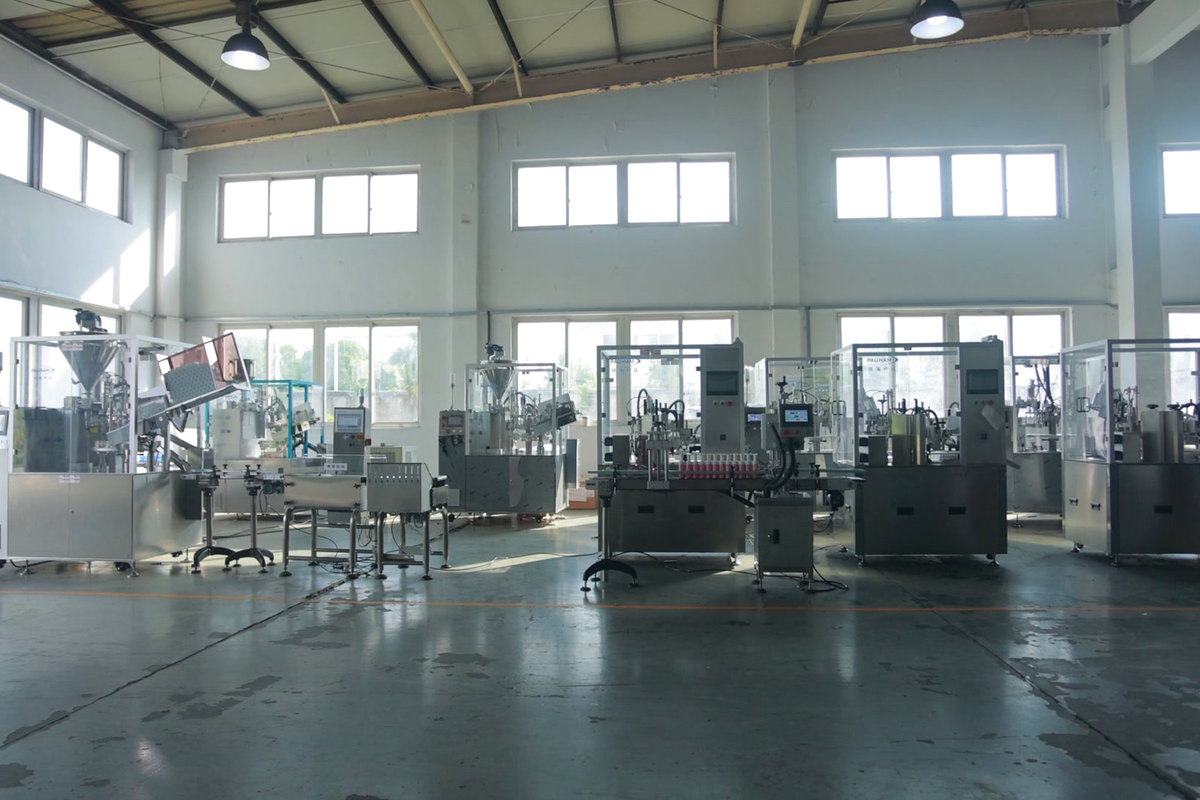
Layout of Cosmetics Filling Production Line Equipment
I. What Steps Are Included in a Typical Production Process?
Depending on the product and packaging materials, a cosmetics lotion and cream filling line typically consists of the following modules: automatic bottle sorting and conveying, bottle cleaning, bottle inspection, metered filling, inner and outer cap application, capping (screw or press), in-line weighing, defective product rejection, batch coding, and automatic cartoning.
These modules are not simply arranged side by side; they also require standardized production rhythms, conveyor control, and exception-handling logic. When a workstation experiences a shortage of bottles or caps, or detects a weight anomaly, the system must be able to identify the issue promptly to prevent the problem from propagating to subsequent packaging stages.
II. Why Do Liquid Formulations, Emulsions, and Creams Require Different Filling Strategies?
Toner has high fluidity, so the key is to prevent dripping and ensure stability at high speeds; lotions have a certain viscosity, requiring a balance between filling speed and accuracy; face creams and high-viscosity pastes may exhibit stringing, wall adhesion, or bubbles, so the feed, valve, and nozzle operations must be optimized based on the material’s state.
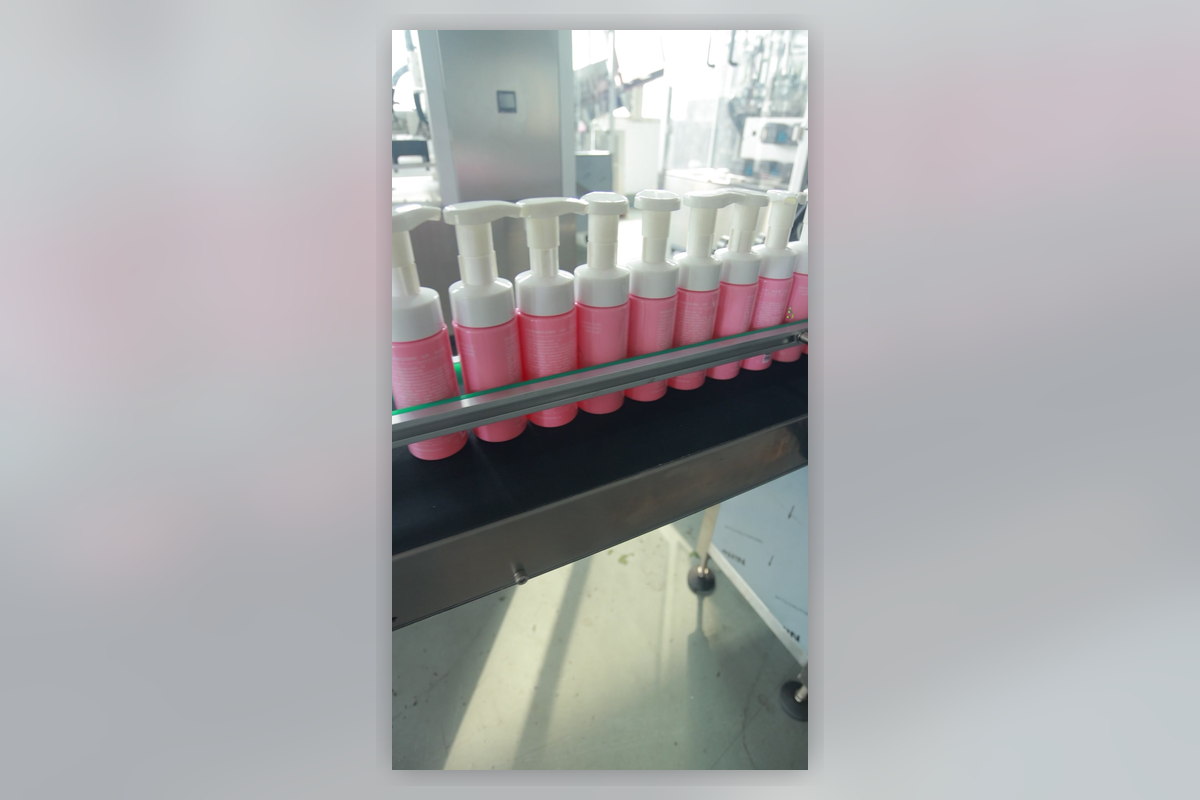
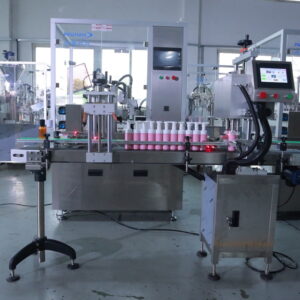
Lotion Bottle Conveyor and Cap-Sealing Process
Therefore, before designing the entire production line, tests should be conducted using actual materials to verify filling volume, temperature, viscosity changes, and cleaning requirements. When a single piece of equipment is used to produce multiple formulations, consideration must also be given to parameter and formulation storage, quick changeovers, and the cleaning of contact parts.
III. Weighing Inspection Transforms Quality Control from Spot Checks to Real-Time Monitoring
Traditional manual spot checks can only identify some issues, whereas online weighing allows for individual inspection of each finished product. When the system detects weight deviations, missing parts, or packaging abnormalities, it automatically rejects and logs the items, helping companies improve batch consistency.
For factories that require batch traceability, it is also possible to link inkjet codes, labels, and inspection data to provide clearer records for production management.
IV. Production line planning should take into account the factory facilities and future production capacity
A production line for lotion and cream isn’t necessarily better just because it’s longer or has more functions. When planning, you should take into account product specifications, target production capacity, staff movement patterns, cleaning zones, upstream and downstream equipment, and future expansion needs. For facilities with limited space, a modular layout can be adopted; for contract manufacturing involving multiple product specifications, priority should be given to changeover efficiency and flexible conveying.
Baohan Technology'sFully Automatic Lotion and Cream Filling Production LineThe bottling, inspection, filling, capping, weighing, inkjet coding, and cartoning modules can be configured according to the factory layout and production requirements. Before finalizing the design, testing with sample bottles, sample caps, and actual product allows for more accurate verification of the line’s cycle time and packaging results.
V. Automation is not about eliminating a single workstation, but about stabilizing the entire process.
A mature cosmetics filling production line must balance efficiency, precision, cleanliness, inspection, and maintenance. When making purchases, companies should consider the stable operation of the entire line, handling of malfunctions, changeover and cleaning procedures, and after-sales service as unified criteria, rather than simply comparing the speed of individual filling machines.
Baohan Technology Development (Shanghai) Co., Ltd. can provide automated filling and packaging solutions tailored to different materials—such as liquids, lotions, and creams—and various bottle types. If you would like to evaluate upgrades to your existing facility, please contact us viaContact UsSubmit the product volume, bottle type, and target production capacity.
When selecting a PE bottle filling and capping machine, it is necessary to consider a combination of factors, including bottle type, product viscosity, capacity, cap type, production capacity, and inspection requirements. This article analyzes key factors—such as changeover efficiency, filling accuracy, capping quality, and in-line inspection—in the context of the cosmetics and personal care industries to assist in equipment selection...
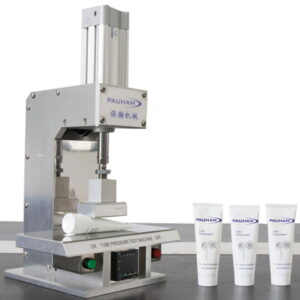
The in-line tube pressure tester continuously monitors the pressure resistance and seal integrity of tubes after filling and sealing, automatically identifies and rejects defective products, and enables seamless integration of seal quality inspection with continuous production lines.
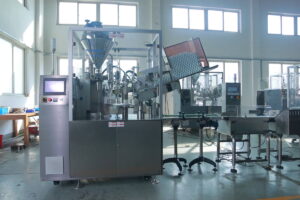
Filling high-viscosity adhesives can lead to stringing and dripping, and consistency must be maintained when sealing aluminum tubes. A closed-loop system must be established covering feeding, metering, filling, cleaning, and sealing, and selection criteria and testing recommendations must be provided.
If a hose end is not sealed securely, conduct a systematic troubleshooting process in the following order: material, hose end, positioning, parameters, cooling, and inspection. Avoid deformation and embrittlement caused by adjusting only the temperature or pressure, and establish a process formula and maintenance checklist.
 Baohan Technology Development (Shanghai) Co., Ltd.